
AI Underwriting: What AI Should Prepare and What Humans Should Decide
Which underwriting tasks AI can take on today, which decisions should stay with a credit officer, and what to require from an AI vendor.
AI underwriting means using software models to do some of the work of reviewing a loan file. In practice it covers two very different jobs. One is preparing the file: reading documents, pulling out numbers, checking what is missing, and pointing out things that do not match. The other is making the credit decision: approve, decline, or change the terms. If you are weighing AI vs manual underwriting, you are deciding where the line between those two jobs sits. This guide draws that line task by task and explains the rules that put it there.
An AI underwriting assistant that prepares the file is useful today and easy to defend. An AI underwriter that decides on its own creates legal and supervisory questions that most commercial, small business, and alternative lenders are not set up to answer.
Tasks AI can handle in loan underwriting today
Much of an underwriter's week goes to assembly, such as keying numbers from tax returns and bank statements into a spreadsheet before analysis starts. That is where AI in loan underwriting earns its place.
Document intake and extraction. Borrowers send tax returns, bank statements, rent rolls, leases, and business financial statements. AI tools can sort these by type and read values off them, such as gross receipts, net income, or monthly deposits. Someone should spot-check the results, especially on scanned pages.
Spreading financials. "Spreading" means laying a borrower's financial statements side by side in a standard format so you can compare years and compute ratios. Once values are extracted, the software can place them in your spread template and calculate figures such as debt service coverage (how many times the borrower's cash flow covers its loan payments).
Missing-item checks. Each loan type has a list of required documents. Software can compare what arrived against that list and flag the gaps on day one, before the file sits in a queue.
File summaries. A summary of a 60-page file (who the borrower is, what they want, key figures, open items) helps a reviewer start faster. It is a starting point for the credit memo, and the underwriter still writes and owns the memo.
Inconsistency flags. AI can point out when numbers disagree. The revenue on the tax return is far below the deposits on the bank statements. The business name on the lease does not match the application. A large deposit appears the week before the statements were pulled. Each flag is a question for a person to look into, and many have innocent answers.
Decisions that should stay with a credit officer
Four sets of rules explain why the decision itself should stay with a person.
Adverse action notices need specific, true reasons. Under the Equal Credit Opportunity Act, Regulation B requires that a statement of reasons for adverse action "must be specific and indicate the principal reason(s) for the adverse action," and the official commentary says reasons based on "the creditor's internal standards or policies" are not enough (CFPB, Regulation B § 1002.9). Adverse action means a denial, or a change in terms the applicant did not accept. The same section covers business credit. For businesses with gross revenues of one million dollars or less, the lender may give the notice orally or in writing. For larger businesses, the lender must notify the applicant of the action within a reasonable time and give written reasons if the applicant asks in writing within 60 days (§ 1002.9(a)(3)). If a model made the call and nobody can say why, you cannot write that notice honestly.
The CFPB's AI circulars were withdrawn, but the regulation was not. In 2022 and 2023 the CFPB issued two circulars saying that lenders using complex algorithms still owe specific reasons. Circular 2022-03 stated that "a creditor's lack of understanding of its own methods" is not a defense (CFPB Circular 2022-03). Both circulars were withdrawn on May 12, 2025, as the CFPB's withdrawn guidance list shows. The requirement in § 1002.9 that reasons be specific is part of the regulation itself and still reads the same. Treat the circulars as history and the regulation as the rule.
Fair lending applies to every step. Regulation B says "a creditor shall not discriminate against an applicant on a prohibited basis regarding any aspect of a credit transaction" (CFPB, Regulation B § 1002.4). "Any aspect" includes how a file is summarized and which flags get raised. If a tool treats similar borrowers differently for reasons tied to a protected trait, the lender owns that result.
Model risk guidance changed in 2026. The Federal Reserve, OCC, and FDIC replaced the 2011 model risk guidance (SR 11-7) with revised guidance on April 17, 2026 (Federal Reserve SR 26-2). The OCC says the new guidance is "expected to be most relevant to banking organizations with over $30 billion in total assets" and may also matter for smaller banks with heavy model use. It covers model development, validation, monitoring, governance, and vendor products. It also states that "generative AI and agentic AI models are novel and rapidly evolving" and are "not within the scope of this guidance" (OCC Bulletin 2026-13). So if your AI tool is built on a large language model, the main federal model risk guidance does not tell you how to validate it. That gap is one more reason to keep a person in charge of the decision the tool feeds.
AI prepares, human decides: a task table
| Underwriting task | AI prepares | Credit officer decides |
|---|---|---|
| Document intake | Sorts files by type, reads key values | Confirms the right documents are in the file |
| Spreading financials | Places values in the spread, computes ratios | Adjusts for one-time items and judges the trend |
| Missing items | Lists gaps against the checklist | Decides what can be waived or deferred |
| File summary | Drafts an overview of borrower and request | Writes and signs the credit memo |
| Inconsistency flags | Points out mismatches across documents | Investigates and decides if a flag matters |
| Risk rating | Shows the inputs and any scorecard result | Assigns the final rating |
| Approve, decline, or counteroffer | Assembles the evidence | Makes the call and owns it |
| Adverse action reasons | Lists the factors the file shows | Confirms the true principal reasons and sends the notice |
A worked example with round numbers
Here is a hypothetical case. A small business applies for a $500,000 term loan. The AI assistant extracts figures from two years of tax returns and twelve months of bank statements. It computes a debt service coverage ratio of 1.10 against a policy minimum of 1.25. It also flags that deposits run about 20 percent above reported revenue.
A tool acting as the underwriter might decline the loan on the ratio alone. The credit officer looks closer. The deposit gap comes from a one-time equipment sale and a line of credit draw, which should not count as income. After adjusting, the ratio stays below policy. The officer offers a smaller loan of $400,000 that the cash flow supports, and records the reason: cash flow insufficient to support the amount requested. The decision and the reason both come from a person who can explain them to the borrower and to an examiner.
What to require from an AI underwriting vendor or setup
Before you turn on any AI underwriting assistant, get clear answers on these points.
- Audit trail. Every AI output (an extracted value, a flag, a summary) is stored with a time stamp and the version of the tool that produced it. You can reconstruct what the underwriter saw when they decided.
- Human sign-off. The system cannot approve, decline, or send a notice without a named person's action. Check that the sign-off is recorded on the loan record.
- Reason codes you can trace. Any score or flag comes with the factors behind it, in words a borrower could understand. Per Regulation B, if a scoring system drives a denial, the reasons disclosed "must relate only to those factors actually scored in the system" (§ 1002.9 commentary).
- Data lineage. Each number in the spread links back to the page and line it came from. A reviewer can click from "net income" to the tax return.
- Override tracking. When an underwriter changes an extracted value or dismisses a flag, the change and the reason are logged.
- Vendor validation support. The vendor explains how the tool was tested, how it is monitored, and what changed in each release. Your compliance team should be able to review this.
- Fair lending testing. Ask how the vendor tests for different results across groups, and whether you can run your own tests on your data.
Where Fundingo fits
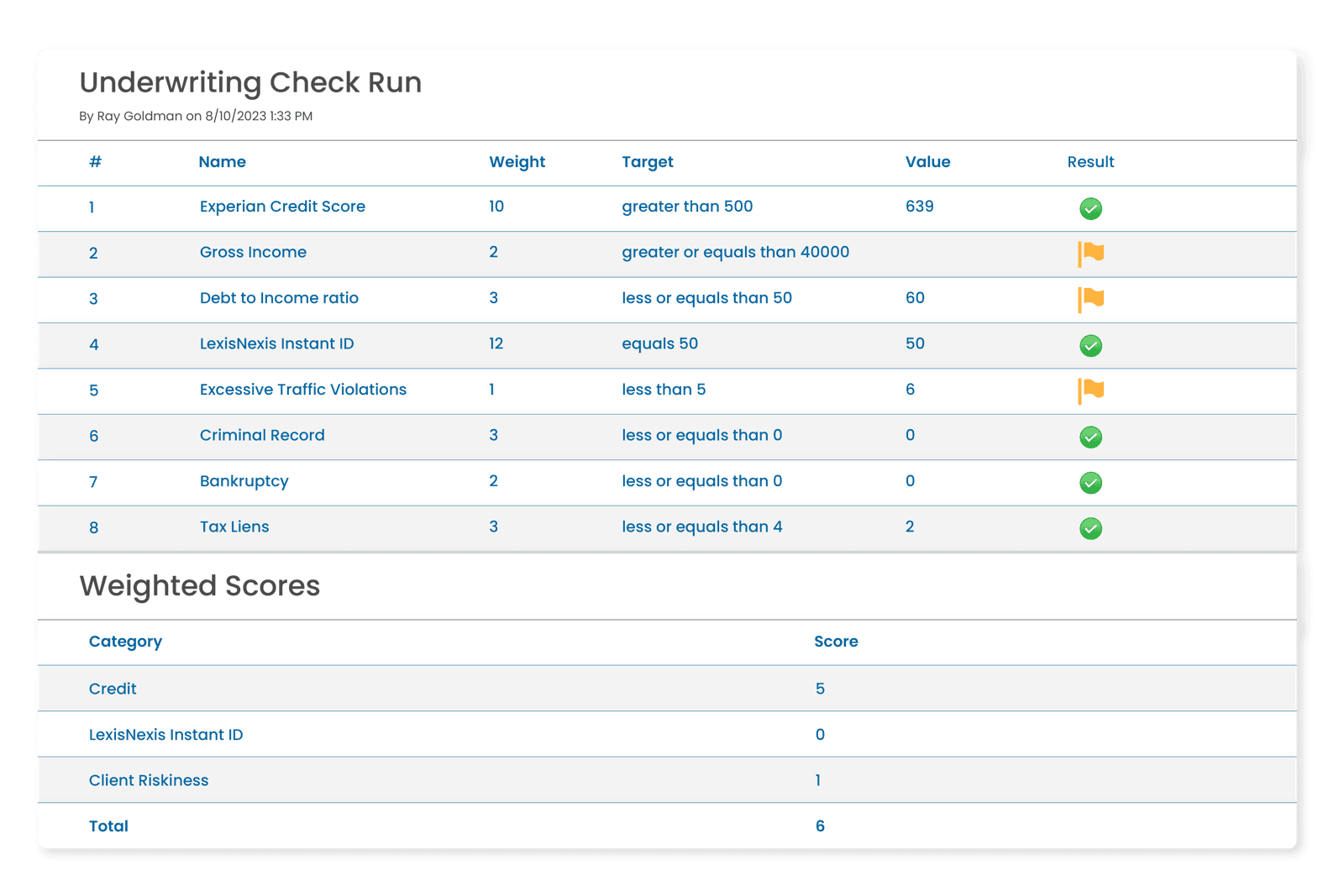
Fundingo's loan origination and underwriting product keeps applications, documents, verifications, underwriting checks, and approvals, including committee approvals, on one Salesforce record. Underwriting check runs show targets, values, and a weighted score in the open. Our agentic loan management page describes an underwriting review agent that "reads the file, the checks, and the flags, and prepares the case for a person to decide." That agent is on our roadmap and is not in the product today.
If you are sorting out which parts of your process to automate first, our guide to automated underwriting in loan processing covers the rules-based side, and our piece on cash flow underwriting covers the analysis that bank statement data supports.
A good first step this week: pick five recent files and time each stage, from intake through the credit memo. Mark each stage as assembly or judgment using the table above. The assembly stages are where an AI underwriting assistant can help first. If you want to walk through that map with us, contact the Fundingo team.
Related articles
A Comprehensive Guide to Automated Underwriting in Loan Processing
A practical guide to automated underwriting: how it speeds up loan decisions, where it struggles, and the best practices that make an implementation stick.
Loan UnderwritingEssential Underwriting Software for Small Business Lenders: A Top 5 Review
Five underwriting platforms reviewed for small business lenders who need to assess risk accurately without slowing the path to a funding decision.
Loan UnderwritingLoan Underwriting Revolutionized: The Role of AI and Analytics in Real Estate Lending
AI and analytics are reshaping real estate loan underwriting, enabling faster, more accurate, and more transparent lending decisions.